

the complex life of trees
the anthropomorphizing of nature

It’s time to burst a bubble. There is no scientific evidence to suggest that trees have thoughts, emotions, and values, intentionally share resources to care for other nearby trees, nurture their offspring as a human mother nurtures her baby, or provide compassionate care to the old and sick around them.
Working closely with forest landowners, I have often been recommended books that imply these beliefs—that trees in forests operate just like utopian human communities—and often are the basis from which landowners decide what they are or aren’t willing to do in terms of forest management activities.
Part of me deeply understands the appeal of wanting to these ideas to be true, yet many of them seemed to go against core concepts that I had not only learned while studying forestry in school, but have directly observed in the field. If I considered myself a forester, it seemed important for me to investigate these claims for myself.
Culture vs. Science
I’ll start by providing a direct quote from the book most commonly recommended to me by new landowners—The Hidden Life of Trees by Peter Wohlleben.1 On page 4 of his book, Wohlleben writes:
“Every tree, therefore, is valuable to the community and worth keeping around for as long as possible. And that is why even sick individuals are supported and nourished until they recover. Next time, perhaps it will be the other way round, and the supporting tree might be the one in need of assistance. When thick silver-gray beeches behave like this, they remind me of a herd of elephants. Like the herd, they, too, look after their own, and they help their sick and weak back up onto their feet. They are even reluctant to abandon their dead.”
It’s clear to me that these words attempt to evoke heartfelt imagery of trees as noble beings living in perfect harmony, helping each other in times of need and feeling love towards one another. It seems to come from a form of respect or reverence for nature—yet, to me, these two sentiments are contradictory. The use of language like “reluctant” and “abandon” imply that trees experience human emotions.
This is also amplified in Dr. Suzanne Simard’s book Finding the Mother Tree2, where the author claims to have discovered maternal instincts in trees, despite there being little to no definitive evidence for this—studies that Simard has been involved in herself show a limited view into a specific type of forest3, with findings too preliminary to confirm as ubiquitous in all forest types or mycorrhizal interactions. This anthropomorphizing of trees rejects any ideas that trees may have different experiences than human beings, or that there might be some way to experience life that doesn’t include emotions, values, and morals in the way that humans define them.
Some argue that it’s a good thing to anthropomorphize non-human life forms in order to increase our ability to empathize with them—the more humans empathize with other life forms, no matter how that empathy is generated, the better support and success conservation efforts receive. When Suzanne Simard uses the term “mother” in reference to a tree, our heart strings are pulled—how could anyone want to cut down a “mother tree”? Yet, there’s a deeper question to ask ourselves: why do we need other life forms to be human-like in order to value them as important parts of our world? Are we truly showing reverence for trees by projecting our own experiences onto them? If anything, it seems to reveal a lack of respect for these beings that we should need to feel like they experience human emotions in order to manage our forests sustainably.
There is undoubtedly a useful time and place in culture to tell stories about the natural world in order to promote certain values or to explain certain phenomena in accessible ways, such as to teach children—there are countless examples of myths and stories in many cultures involving nature—yet there can be a point where these stories obscure our ability to see reality. In other words, they can morph into outright lies that we unknowingly propagate in a game of pseudoscientific telephone. Cultural stories that cross this boundary often create detrimental belief systems that can be extremely difficult to shake once they take hold. They may yield positive short-term results, but can have lasting unintended consequences in our relationship to the natural world.
There are many examples of these beliefs. The fact that trees emit certain pheromones or chemical signals in response to attacks from insects and disease is often cited as proof that trees are intentionally communicating with their neighbors, compassionately warning other trees of danger. However, there are other explanations on offer that have not yet been eliminated. For example, emitting signals via air is a faster way for a tree to warn its own outer branches of an attack rather than sending the signal internally, where communications may travel very slowly. So, if trees are sending chemical signals through the air to signal danger to their own outer limbs, does that prove that they also have intent to warn neighboring trees? And that, in this process, other trees haven’t simply evolved to pick up on this signal and put their own defense systems into action to improve their chances of survival?
The answer is that we don’t know. It seems that this is one of the points at which this story borders on a lie. Rather than admitting this claim to be a speculation, or simply an exercise in imagination rather than based in any factual evidence, it is presented in books like those mentioned above as a given truth.
One of the most common examples I hear is about the supposed egalitarian tendencies of trees—a story about how trees will politely grow away from each other in order to not impede on the growing space of a “friend”, so that they may both benefit from an equal amount of resources. This seems to be a manipulation of the phenomenon of crown shyness, observed in only a handful of tree species. It’s a lovely sentiment to imagine trees experiencing friendship and consideration for one another, being courteous only to take up the space they need. Yet this leaves out several important points: the fact that the physiological explanation for crown shyness has not yet been identified (and is thought to be an adaptive behavior to protect against threats like wind damage or insect infestation), as well as one of the most significant factors of forest ecology—shade tolerance.
Light Governs All
Sunlight is the most important resource that trees are after, even before any water or micronutrients in the soil; without sunlight, they are unable to photosynthesize and produce the sugars they need to feed themselves. In general, trees will not put precious energy into growing branches where light is not available. If the branches of other trees are already present in part of the forest canopy, it doesn’t make sense for another tree nearby to waste its energy growing in the same direction where light is limited. I have also often seen more vigorous tree species that have been suppressed in the forest understory growing straight through another’s crown in order to reach the light. Furthermore, it is widely known that certain trees are a lot more tolerant of shade than others. Shade tolerance is often one of the most heavily weighted considerations when planning forest management activities—just like any other activity that involves tending to plants.
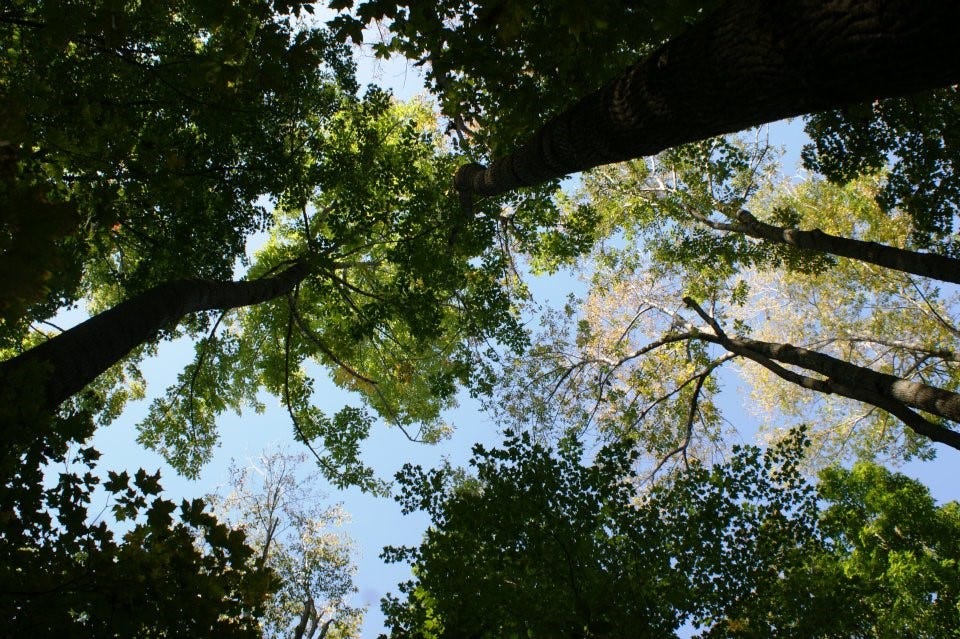
Trees that are intolerant of shade are easily out-competed by shade tolerant trees. In the temperate forests of the Northeast where I reside, maples, beeches, yellow birches, and hemlocks are all shade-tolerant Northern Hardwoods that, given time, will out-compete oaks, hickories, and cherries every time. In the same way a gardener would not choose to plant a shade intolerant shrub beneath the crown of a large tree, or wouldn’t expose a shade-loving plant to the scorching hot sun in the middle of their yard—a good forester is mindful to tend the forest in ways that will benefit the needs of different tree species. At times, this means leaving parts of a forest undisturbed, and at other times, it means thinning the forest canopy to redistribute light across the forest floor.
Let’s return to The Hidden Life of Trees for a moment. My intention is not to target one specific author or book, but it feels particularly important to bring attention to this claim since it has the power to directly influence the management decisions of landowners. Wohlleben challenges the idea of thinning by discussing beech trees, Fagus spp., and their tendency to grow closer together, apparently for the purpose of sharing resources amongst each other, which can be disrupted if they are thinned out. On page 16, he states:
“[…] it is not possible for the [beech] trees to grow too close to each other. Quite the opposite. Huddling together is desirable and the trunks are often spaced no more than 3 feet apart. Because of this, the crowns remain small and cramped, and even many foresters believe this is not good for the trees. Therefore, the trees are spaced out through felling, meaning that supposedly excess trees are removed. However, colleagues from Lübeck in northern Germany have discovered that a beech forest is more productive when the trees are packed together. A clear annual increase in biomass, above all wood, is proof of the health of the forest throng.”
Reading this, a landowner may be easily convinced that silvicultural practices like thinning are in fact detrimental to the forest, and are only done in the interest of producing timber. Contrary to ideas spread through popular media, books, and opinion articles galore—many foresters have motivations far beyond timber production to manage forests responsibly and sustainably, and recognize forests as an integral part of our Earth’s ecosystem. In my experience, even those that do primarily focus on the production of timber are often some of the most invested in maintaining the health of forests for generations to come.
Motivations aside, and despite this claim being based in unpublished (and therefore non-peer-reviewed) research, it also ignores several important characteristics specific to beech—including, again, shade tolerance. Beeches are one of the most shade-tolerant tree species around. They thrive in shady conditions and have adapted to being browsed by animals by becoming prolific root suckerers, forming dense thickets from the roots of a single established tree. Cutting down a single beech tree can result in hundreds of root suckers popping up from the roots of that tree. Many of these root suckers can grow into full-size trees, leading an observer to believe that they are growing independent of one another. Foresters have been aware of this for decades. A tree is not “sharing” its resources if, in fact, what seems like individual trees is actually just shoots from one single tree. It’s a single organism distributing resources out over its own structure. In addition, very few tree species have the ability to root sucker in the way that beech can. It’s unlikely you would find other trees exhibiting this same supposed “resource-sharing” behavior unless it were occurring by other means in the soil.
The Wood Wide Web
This brings me to another story that is beginning to teeter on falsehoods—the role of common mycorrhizal networks in forests. For those unfamiliar, “myco-” means fungi, and “-rrhizal” means of the root. This term is used to refer to the subsoil network of mycelium which grows among the roots of plants and trees, and is said to connect the forest together underground in a “wood wide web”. Of course, there is scientific evidence that resource transfer occurs in this way via mycorrhizal networks—but it’s important not to jump to conclusions beyond what we have been able to show and replicate in science.
More importantly, we should be cognizant not turn these preliminary findings into narratives that project human qualities onto trees and fungi. Research on mycorrhizal networks and resource transfer between trees within these networks is still in its beginning stages. The “how” and “why” of this process are vastly complex and largely unknown. To assume that we know close to anything complete about the true function of mycorrhizal networks—and also to not acknowledge that there are likely thousands of functions that these networks perform given their complexity—seems arrogant to me.
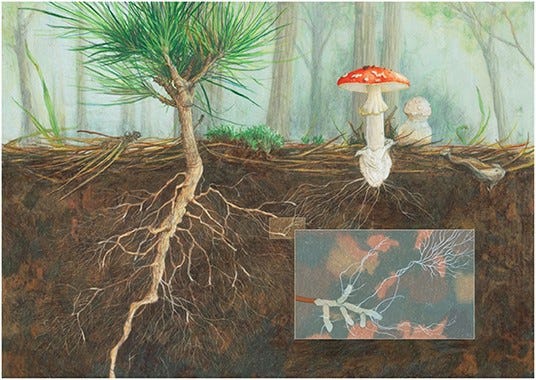
The current dominant narrative surrounding mycorrhizal networks in forests declares that trees use these networks to “talk” to each other, as well as other flora and fungi in the woods, and share resources in a mutualistic collaboration. This narrative would be groundbreaking if true, as most understandings of ecological relationships between organisms have been those of competition, not collaboration.
While I don’t entirely disagree with the idea that trees and fungi could be participating in some version of collaboration and resource-sharing, the evidence available is nowhere near definitive for me. An overwhelming majority of the studies conducted on common mycorrhizal networks amongst trees have been in greenhouse nursery settings—or in other words, in pots which do not at all resemble the ecology of forest trees. In addition, these trees are typically seedlings or saplings—smaller, younger trees that also do not accurately represent mature forest trees. Studying subsoil networks of any kind, especially of mycelium, is extremely difficult to pull off in-situ. As you can imagine, directly observing these networks in the soil using the technology available to us today almost always requires a disturbance of the soil, and thus, destruction of a portion of the network. Compromising the network obviously poses many additional obstacles to consider when conducting a study, and potentially alters the results to a point that renders them unreliable. Since this is so risky, it’s much easier for scientists to attempt to construct artificial situations where tree seedlings, in a controlled setting, are manipulated using artificial barriers such as mesh screens in the soil where mycelium can’t penetrate4.
Yet even with these methods, there are issues. Artificial barriers also potentially interfere with flow of nutrients through the soil medium—an important pathway through which trees get water and various nutrients. If tree roots are cut off from the mycorrhizae using these barriers, yet the barriers additionally impede the ability of nutrients to move through the soil or for tree roots to forage freely, then it would be impossible to tell which factor would’ve caused a decline in the tree’s health. As scientists Justine Karst, Melanie Jones, and Jason Hoeksema put it in their recent article reviewing the scientific literature on common mycorrhizal networks5, “Mature trees are not large seedlings, and forests may have emergent properties.” In this same article, in a section concerning the claim that resource transfer within common mycorrhizal networks (CMNs) increases the performance of tree seedlings, Karst, Jones, and Hoeksema write:
“Implicit in this view, and captured in this popular claim, is that fungi forming CMNs are physical extensions of roots (that is, passive conduits in which the direction of resource flow is determined by plants). This view conflicts with fungal behaviours involving purpose and intent and overlooks that mycorrhizal fungi do not always benefit their plant partners. […] for every study interpreting CMNs as mediating interplant resource transfer or benefitting seedling performance, the results can be explained without invoking CMNs.”
This is what I mean by the research being in its preliminary stages—in order for a scientific observation to be accepted as significant, it must be thoroughly vetted, investigated, and most importantly, reliably replicated. All other possibilities or explanations for a given observation have to be explored and systematically ruled out before a conclusion can be made. This is simply the scientific method. Certainly, these early stage findings are exciting, and possibly hint at a whole world of possibilities within the forest that we have yet to discover. But it would be a shame to close the door on discovering what is truly unfolding in forest ecosystems for a narrative that simply got carried away too soon.
Leaving the Bubble
A cultural story of trees following utopian human values of equality and community has been invented as a result of these premature claims, and is indeed a highly appealing story—painting an image of a magically balanced world in nature which we humans long to connect with and mimic in our own version of society. There’s no confusion about why a story like this would anchor itself into the hearts and minds of many, or why so many of us would long for it to be true, despite the fact that it may not be. I’ve written this article not to be cynical or to submit a hostile criticism of these stories, but as a reminder to remain ever-curious about the bubbles we might be surrounded by in our lives. I would encourage all reading to dive into the literature for themselves with questions at the ready. We are not served by bubbles—only shielded from a reality that we all have a responsibility to perpetually uncover.
References
Wohlleben, P. The Hidden Life of Trees: What They Feel, How They Communicate—Discoveries From a Secret World Vol. 1 (Greystone Books, 2016).
Simard, S.W. Finding the Mother Tree: Discovering the Wisdom of the Forest (Knopf Doubleday Publishing Group, 2022).
Beiler, K.J., Durall, D.M., Simard, S.W., Maxwell, S.A. and Kretzer, A.M. (2010), Architecture of the wood-wide web: Rhizopogon spp. genets link multiple Douglas-fir cohorts. New Phytologist, 185: 543-553. https://doi.org/10.1111/j.1469-8137.2009.03069.x
Simard, S., Perry, D., Jones, M. et al. Net transfer of carbon between ectomycorrhizal tree species in the field. Nature 388, 579–582 (1997). https://doi.org/10.1038/41557
Karst, J., Jones, M.D. & Hoeksema, J.D. Positive citation bias and overinterpreted results lead to misinformation on common mycorrhizal networks in forests. Nat Ecol Evol 7, 501–511 (2023). https://doi.org/10.1038/s41559-023-01986-1
oh here from 'nobody in taipei loves me' 's rec and this is so good! i love how you debunked pro environmental content from a pro environmental standpoint because it's getting increasingly rare to see people challenge the arguments of their own "party" nowadays due to radicalization and whatnot.. also the point you raised about how we have "being human/human-like" as an unspoken criteria for things to be worth saving is fascinating and i'd read another full essay on that if you ever felt up to it :D good tidings!